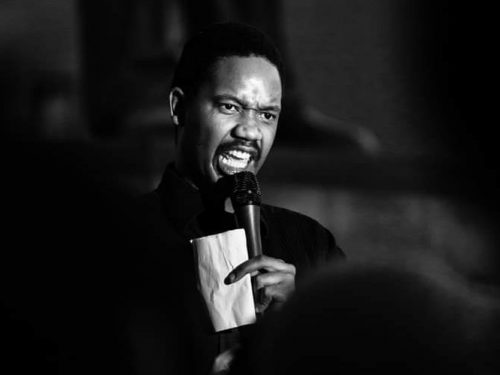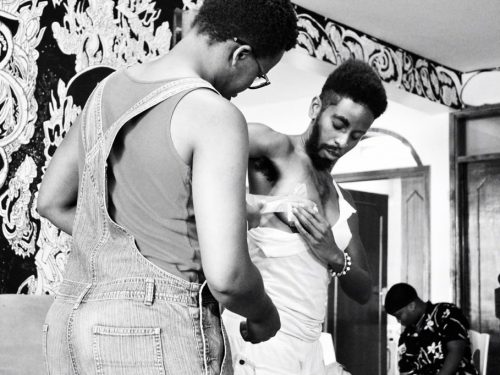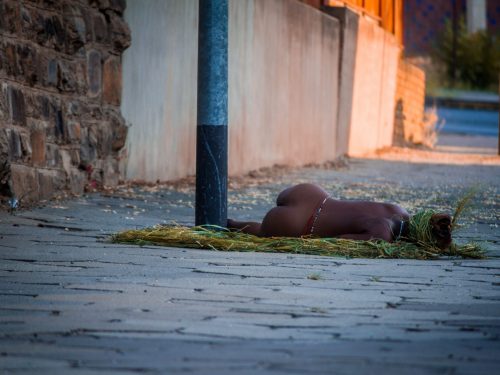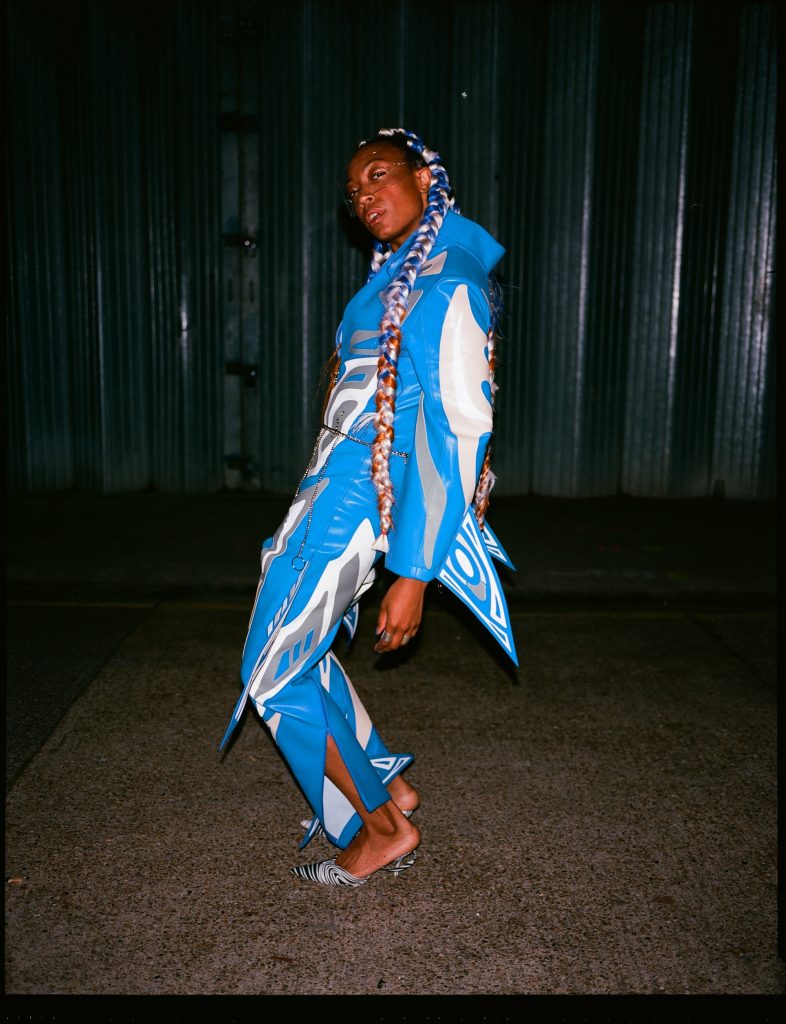
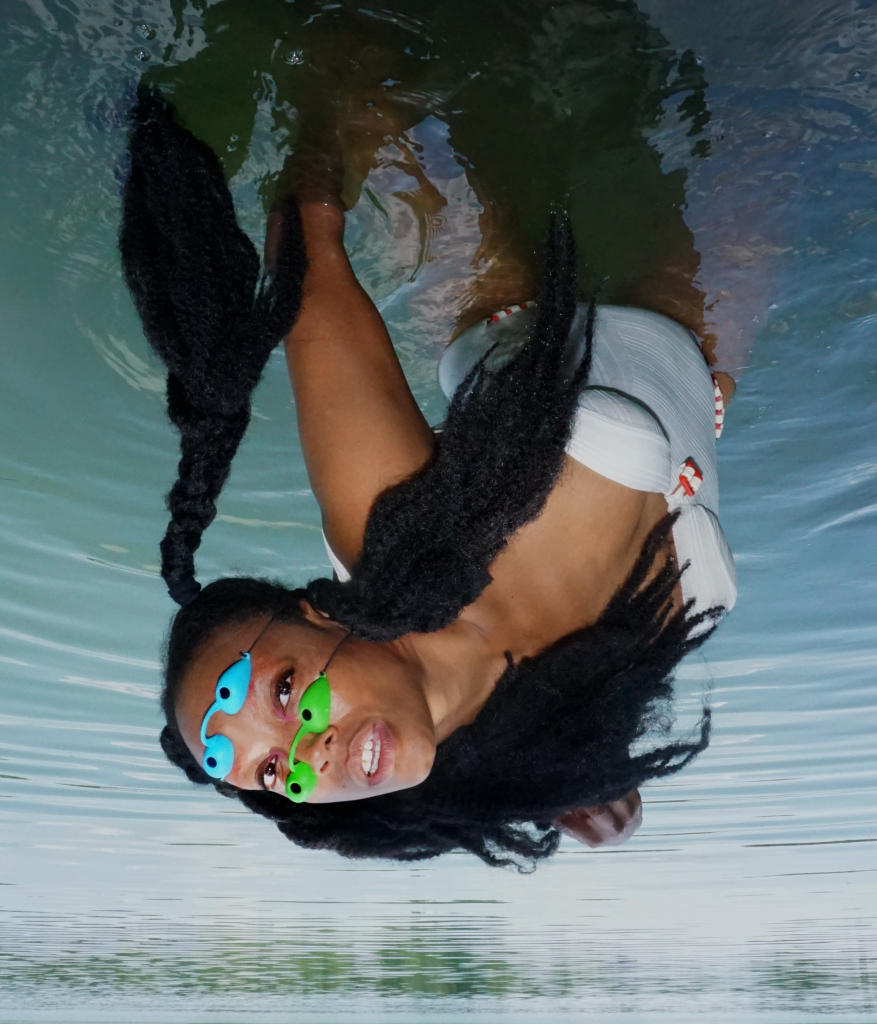
GLOR1A (she/they) exists in the nuanced spaces of a multitude of identities, “I’m half Nigerian, quarter Carribean and quarter British. This mixed bag gave me lots of unique experiences when I was growing up,” the artist says.
This growing up, was in a highly religious Nigerian household in Yorkshire, England until the age of 6. Raised on old gospel and then later, power ballads, pop and soul music, GLOR1A credits the time spent living with her mother for some of her strongest musical influences.
“My mum also loved jazz, so we heard the voices of the most powerful female performers. That’s the backbone of my musical influences – gospel and power ballads. When I started buying CDs, I loved USA RnB, then the harder side of UK music – garage and hard house. A mad mix.”
Their five song EP, Testify, released in 2019, is a reflection on how these varying sounds amalgamate into the artist’s music. Songs including U Up?sound like a hypnotic futuristic sequel to Kelis’s 90s hit Caught Out There (I Hate you So Much Right Now) with a cool neck-breaking beat to accompany the relatable spiral of being in an unfulfilling situationship. The song Left Behind is a haunting testament to the old gospel and power ballads the artist grew up on while the black and white visuals for Second Chances glitch into the neon-tinged loneliness of a cab ride home after a night out for the song Friends.
In a conversation that explores the intimacies of her new song Juice, the thought-provoking short film Dark Matter Inc and the powerful IGTV series Dystopian Futures, I spoke to GLOR1A about Black futurism and their desire to connect across the African diaspora.
Welcome to GLOR1A’s land; a Black futurist, multidisciplinary, feminist utopia…
How would you describe your own work?
Playful. I’m rooted in RnB music but I love to experiment. The last track I released was an RnB slow jam. The one before, I was screaming about f*ck boys and vices. I describe my work as female empowerment. I like to create voices for the people who may not be as heard as others and, just say it bluntly. Queer, black, brown, female. The new work is a lot harder, I’m trying to lean into the hidden punk in me screaming to get out.
A lot of your work operates on so many levels with the speculative; the Black speculative to be precise. How did you find futurism?
I have some super switched-on, brilliant friends who are artists. Their minds amaze and delight me. I love picking at them. They put me onto futurism in a big way. I started with Moor Mother from a recommendation from Gaika who had played with Moor before. Their mind is fantastic and when I saw Black Quantum Futures I was totally hooked. The way they weave fact, experimentation and centre blackness completely got me. The study of Sun Ra with my friend Remi has also been touched on in my practise. We spend endless hours wondering why Black people think they are from Saturn and how our futures are so entwined with our ancestors. I also class artists such as Missy Elliot as real artistic futurists. I’ve loved her since day one; her vision created with Hype Williams was what I always aspired to. It was Black, unapologetic and totally forward thinking.
I got into other futurists from great minds like my housemate Mark. He is a wizard on YouTube. He introduced me to Jaron Lanier who was urging people to own and sell their own data. It was a pretty simple concept to me but something I hadn’t thought about before. I started deep diving into data sales, tranches and mining and was totally shocked at what I found. I decided to create my own piece on this. Dark Matter Inc, a fantastical story about Black people globally being connected to a Black VPN which allows them to mine and sell their own data collectively. This piece raises many questions about Black capital, socialism, and more. However it also creates some tangible answers. Black people need more connected global infrastructure in the race for the future.
‘The main themes I work with are technology and its effect on art, surveillance, state voyeurism and creeping totalitarianism, global Black connectivity, global citizenship and Black capital’
What themes do you try to unpack in your futurism and what mediums do you mostly gravitate to?
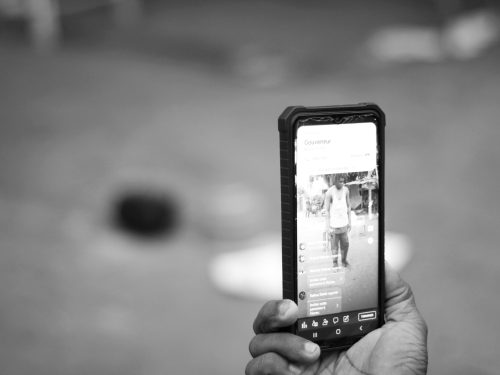
The main themes I work with are technology and its effect on art, surveillance, state voyeurism and creeping totalitarianism, global Black connectivity, global citizenship and Black capital. I use music, performance, poetry and digital utopias to create conversations around these topics. I also have an interview series called Dystopian Futures, which I use to unpack many issues on how technology effects art and our lives.
What is an essential part of your creative process? How do you work from an idea to a fully actualized product?
I’m really spontaneous with how I work and it’s usually from stimulation. I struggle hard to write like just sitting down and thinking. Sometimes I wake up in the morning with songs I’ve dreamt about and I hum them into my phone. With art, it starts with a feeling or topic; something I want to unpack and develop and I start researching. This is the fun bit because knowledge is power. My wormhole deep dives and I create the maddest connections that also strengthen my music and writing. I love a good dig around.
What aspects of working from a Black futuristic perspective have been challenging for you? How does your work speak about these difficulties and overcoming them?
I haven’t faced much challenge yet, but I think that’s because I’m in a period of transition to fully using my voice for the perspectives I’ve discussed above. Last year I started to experiment with more Black futurism in my work. I also started a company with three other amazing British Black artists called Nine Nights, a music tv series and production company, which creates Black futurist music TV. We wanted to create a space for multidisciplinary conversation. In 2021, this is where it will all grow. It may be best to ask me this question in a year’s time.
So, Juice dropped a couple of months ago. How has the reception been?
Very good actually. I hadn’t released a single for a year due to push backs on timelines with covid, but the reception was really heart warming. I wanted to create a soothing space of female passion; alien to some but intriguing to others. I’m super happy people love it and it’s spurred me on to release a lot more music in 2021.
The message of the song Juice is “To communicate in love and lust is our oldest sensual pleasure. During times of restraint, this track reminds us of the beauty of the other human – to honour their existence and reach ecstasy to release tragedy.” Why do you think that message is important now?
In 2020, I was struggling with grief, grief of my past life, grief of a friend passing, grief of Black deaths daily from America’s racist police to the UKs disregard for frontline (mostly Black and Brown) worker’s lives. I was constantly thinking if my immediate family would be next. This weight was heavy, and when I wrote and also created the concept for the Juice video, I knew I needed to tap into pleasure. It was the only way to keep living. Harness my erotic power as activism.
The song is an intimate exploration of reciprocity and indulging in pleasure. In her 2020 book Pleasure Activism, Adrienne Maree Brown unpacks the politics of how healing and happiness can be a crucial part of our activism. Is this something that you hope a lot of your art speaks to? Is this a reoccurring theme in your work?
Haha! We are totally on the same page here. Yes. I have always thought that pleasure and erotica are potent ways to create change. This is the moment we truly release, we exchange without facade and we are open to new light and ideas.
I love that book and Adrienne speaks to my practise a lot. I never knew there was a way to coin what I felt before reading her. Audre Lorde is also a big favourite of mine. She depicts power in her being, her sexuality, her desires and her needs. When I read Sister Outsider, I had the upmost respect for her and realised I can do whatever I want, love whoever I want and be wherever I want.
What new perspectives and futurist insights has the pandemic brought you? Especially after your Dystopian Futures series on IGTV. What conversation was the most striking for you?
Hmm that’s a super tough one. I feel like the perspective hasn’t changed. Last year the more we entered the pandemic, the more it brought my thoughts and fears to the surface. We are all walking blind as a collective. We lack empathy and have short attention spans like fishes. Our highly malleable minds are being tapped into daily from our phones and we don’t really care about who’s watching us in the name of fascism. Dystopian Futures was a great way to highlight that to everyone. The artists were so passionate and I loved our discussions. It’s actually really hard to pick one – I’m sorry!
What resonated a lot with a lot of the Black people who’ve seen the film Dark Matter Inc is the concept of Black people owning their own means of production. In what ways do you think the message “harness your existence” could help liberate Black people from oppression?
It’s a question for you. Dark Matter Inc is a think tank almost. One that is open to interpretation and to start conversations as you have pointed out.
What oppression do we face? And how can we tackle it? With countries like France passing laws that tap phones and monitor conversations about politics, philosophy and religion, you get to see that data is power; power that can be used for and against different demographics at any time. One thing I highlighted in Dark Matter Inc was the need to sell data to make sure it is fairly used. Right now AI and the data it is sold is biased. Your name can stop you getting a mortgage or bank account; it can red line you before you’ve even started. If you owned your own infrastructure and means to using that data would this still happen?
What is exceptionally important about Dark Matter Inc is its critique on the white gaze, it’s outlining of how colonialism impacted Black lives and even how the global pandemic has affected Black people. The film is so incredibly relevant, what inspired the film and who did you work with on the project?
Thank you. I wrote the film using Jason Lanier as a jump off point. I worked out how I wanted it to be shot. I wanted it to feel like a public service broadcast on Zoom. Lo-fi but with powerful words. Gaika really helped bring it to life with music. His scores have so much emotion. It was beautiful to marry both of the pieces together.
There is so much Dark Matter Inc calls into the centre for examination, it is thought provoking from beginning to end, are there any things about the film you’re especially proud of?
I like to see all my work as development pieces. For Dark Matter Inc I see that film as a prototype for a concept that I’ll be developing further this year. I really want to bring more visual art and performance to the next piece. I am going to be developing the concept into a two day show at the ICA in London this year, and with that bringing together more film and media.
‘Nation states are dictatorial and globalised Blackness isn’t a thing.’
In our conversation at the online Art & Tech Summit 2020 that took place in November 2020, we speculated about the ways in which technology could “save us”. The conversation inspired a lot of great dialogue and it also brought up the disparities in the ways we navigate the concept of the future across the African diaspora. In what ways do you feel there is validity in recognizing these differences? In your opinion, how does the concept of a collective Black futurism in art speak to overcoming these disparities?
One bit I added to Dark Matter Inc was about a global nation state. Two reasons why this cannot work; nation states are dictatorial and globalised Blackness isn’t a thing. We have different experiences and also different wants, but brought together in unity to lift our people up. We are bound by the colour of our skin, our connectivity to our ancestors and the appreciation of this earth we walk on. Black futurism has a place connecting different communities of Black people despite their differences because of the above. We are the past and the future and I feel conversations like the ones we had are great at highlighting our differences and creating a unison in thought. I would love to hear more futurism from the continent. It was really eye opening and made me realise that titles and approaches that were not coined by Black people (like Afrofuturism) don’t serve us well.
What texts, theories, films, music and overall art mediums do you consistently return to? How have these works contributed to the ways in which you think about [making] art?
I’m into the simulation theory at the moment and also surrealism as both of these seem to be interlinked. We are in a similar position in the west, as the surrealist period and the idea of fascism and extreme views seem to be emerging in art. I want to counter-argue negativity and push a raw sound to speak about these times correctly. I love the Nyege Nyege label. I see that as a super future in sound and approach and it is definitely an influence, moving forward. Like I said, consistency is a hard thing for me. Even I have the attention span of a fish so I like to fish around for new ideas as I go. Right now it’s post-punk sounds from girl bands in the US and UK. Reading? I’m quite old school but I’m reading Black Man White Mask by Franz Fanon. It’s interesting to see our struggles have not really changed in 60 years.
What do you hope to create in 2021 and what new projects can we look forward to?
Ohh so many projects. I am excited to explore technology more in my work. I’m developing Dark Matter Inc into a stage show with haptics. I’m also working on SWARM, a digital Black femme Utopia which is an online performance platform. I’ve started scoping out a new show too. It’s linked to the environment. I care about environmental justice and I aim to channel that more into my work this year. I don’t know where to start but if this year is anything like last year it will be beautiful.