Interview: Told to Nana Ocran, with all images courtesy of kyle malanda.
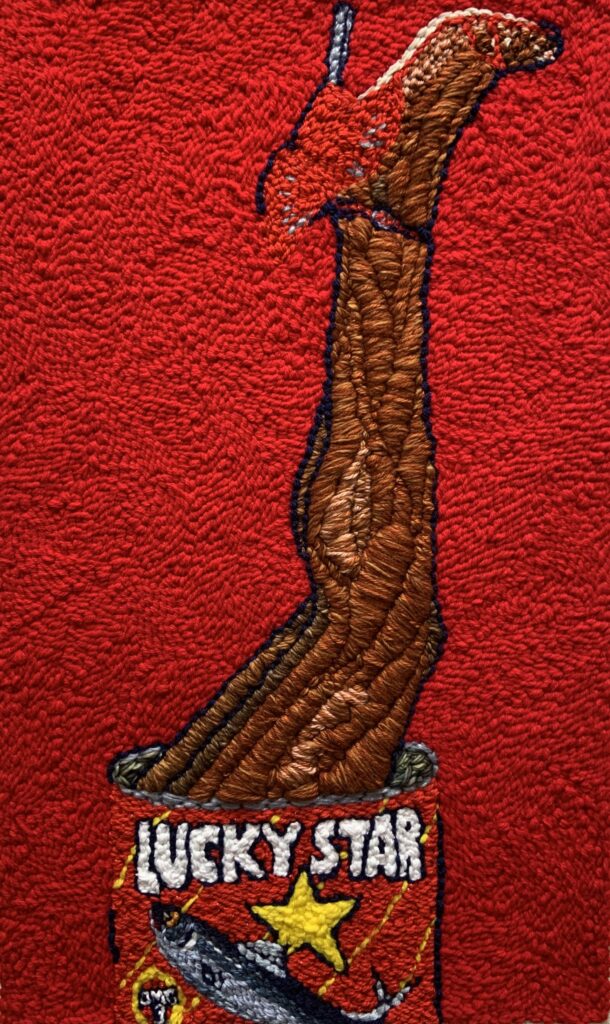
‘I just can’t seem to stop making work about dying! I find death fascinating. I’m especially drawn to funerary rites and how identity is formed and defined through death. I think often about the tension between how we see ourselves and how others see us. Death magnifies this chasm, especially when we’re no longer alive to correct or challenge perceptions around the contours of our identities.
Honestly, artwork and making saved my life. I was very, very depressed with feelings of darkness, depression and isolation. These themes are present in my earlier works. Prayers in Rage Minor was one of the first pieces I did after a two-year hiatus from my practice. It was something that I wanted to make for a long time but hadn’t found the visual language for it. The short of it is that I was very angry with God. As I thought about how to channel that rage into my work, Prayer in C by Lilly Wood & the Prick and Robin Schulz kept playing in my head. The lyrics in the song question why God allows evil to prosper and how difficult it is to forgive that. The title is an homage to that song.
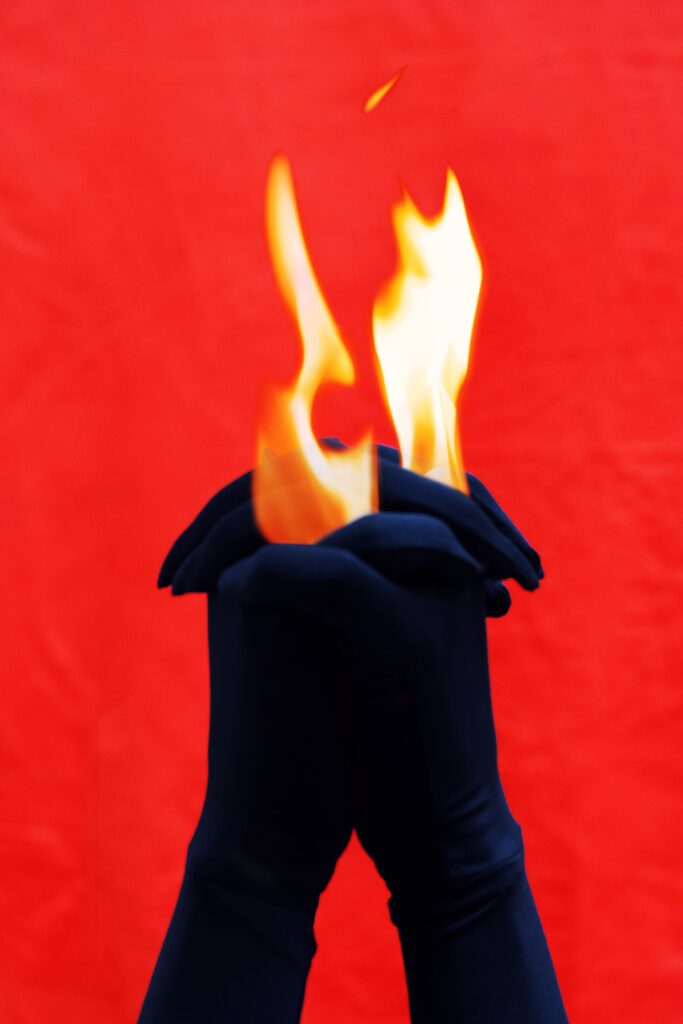
As a third culture kid and a child of an interethnic marriage, I’ve always wrestled with identity. That struggle is especially pronounced in my work, where there’s always an identifying feature – usually the face – missing from the subject. I am there but I am not.
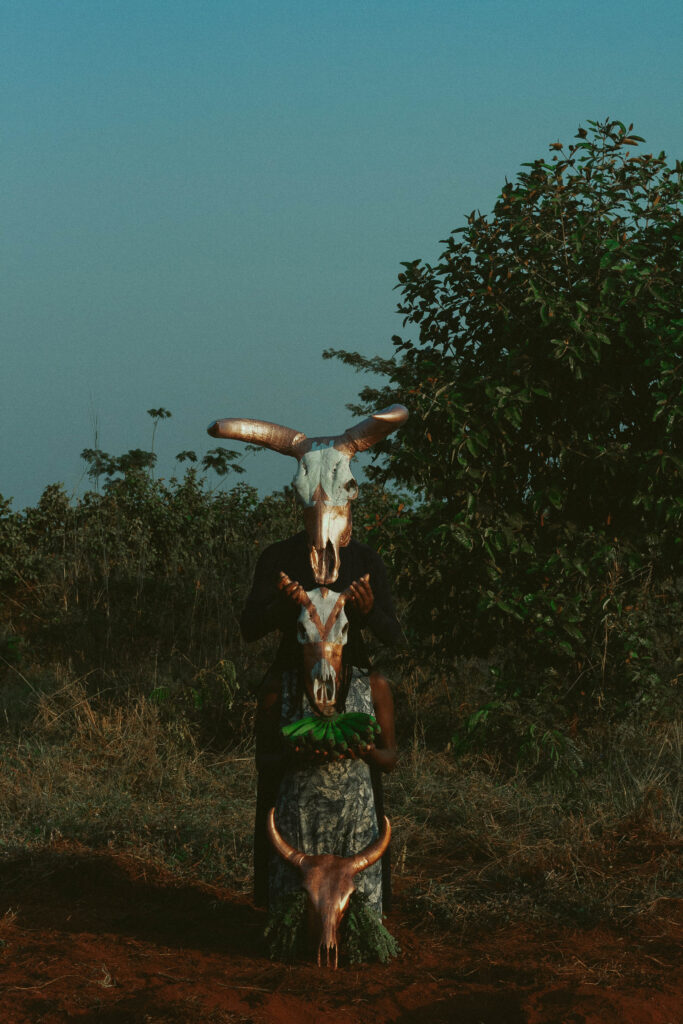
I made Who Will Bury You in 2018, a body of work that I shot on the land that my father inherited from his mother because he’s from a matrilineal ethnic group. I’ve always been my parent’s strange child so I remember requesting, “hey can you guys get me cow skulls?” and they were like, “for what?’ and I‘d say “for stuff” … so they got me these skulls which I ended up sanding and preparing with my sister, who helped me, because preparing a fresh cow skull is really disgusting to do.
I’m excited to spend the next 3 months, at the Pro Helvetia residency, creating HOME IS WHERE I WANT TO DIE – a series exploring identity and belonging through funerary rites. It’s a meditation on alienation as an African migrant. Most of the works will be hand-tufted and hand-embroidered and I’ll also be publicly sharing a Polaroid film project I’ve been working on since 2022. This will be the first time I produce a series with both textile and photographic outputs and I’m ecstatic to have my mediums in visible conversation with each other.
The idea for HOME IS WHERE I WANT TO DIE started revealing itself at the height of the pandemic. I was stuck in the US at the time. Even if I could have left, I wouldn’t have been able to go back to Malawi because the country had specifically banned travellers from the US coming in for two years. You know, I’m ok with dying, but I can’t die here. I need to die at home. I started to explore this by having conversations with Africans in the diaspora. Taxi drivers, strangers … and as much as we’ll live and earn money in America or Europe, most of us don’t want to die in the abroad. I wanted to explore what that means and how we define identity through death and through finding home not as a place where we’re living, or even want to live, but as a place where we want to die, the final resting place, and that relationship between the body and the land.
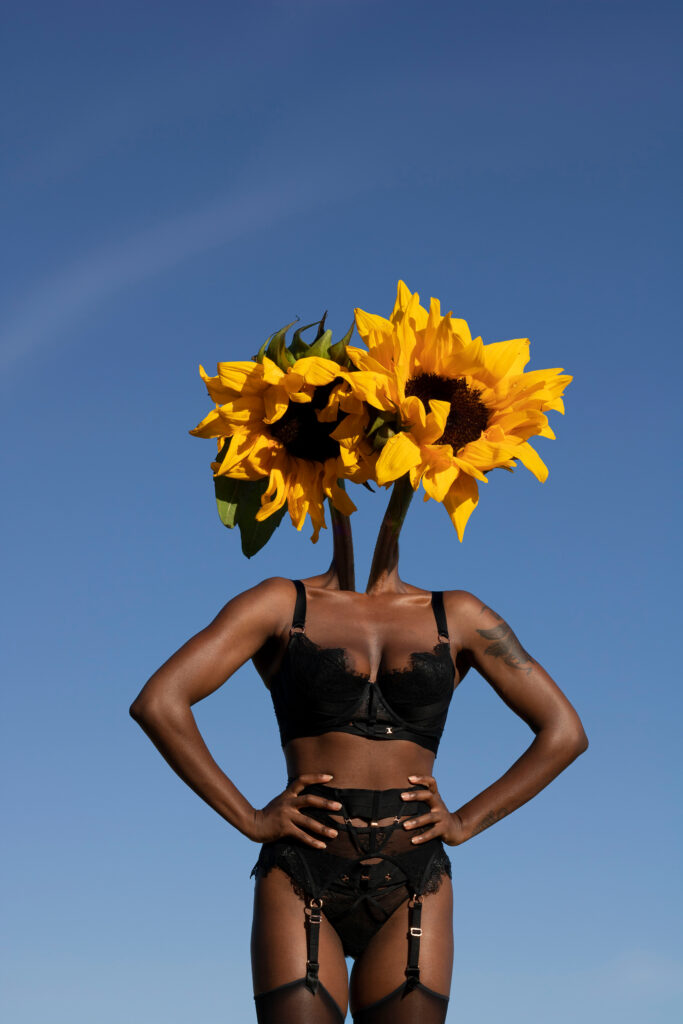
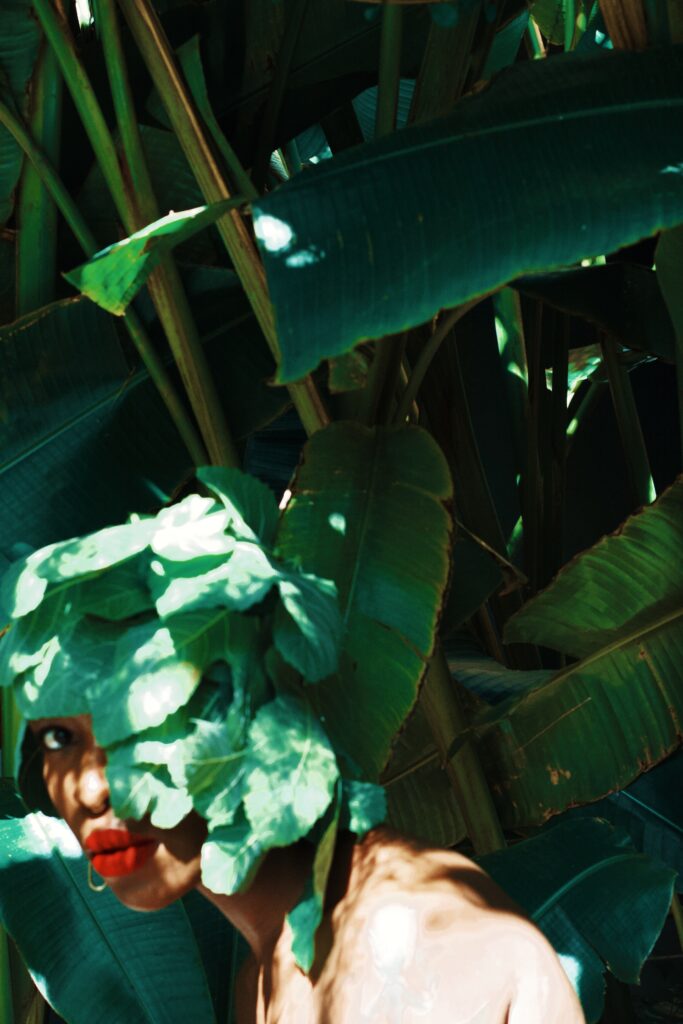
While some of my past work has included botany (SURREAL EROTICA, 2020), I’ve become increasingly interested in ethnobotany – how the relationships between people and plants shape culture. The flame lily is a gorgeous, toxic climbing vine native to Malawi. It looks extraterrestrial and any part of it will kill you, which makes it the perfect inspiration and protagonist for my ongoing nighttime series, MY BEAUTY IS POISON, which is about violence, vengeance and a return to the self. These indigenous plants represent the land. That’s why you see them replacing the heads of the subjects in my work (Salve in the Wound, 2024), and we’ll see more ethnobotanic references in HOME IS WHERE I WANT TO DIE.
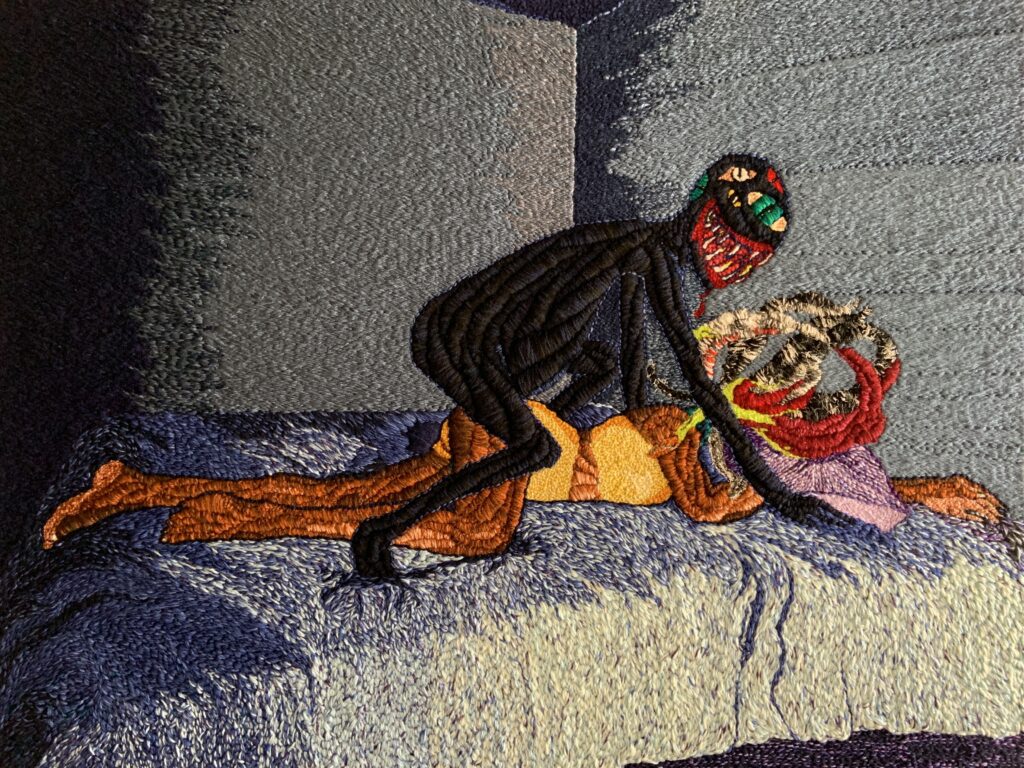
A lot of supernatural thought does inform my work, and this is just a tangent, but …. I’d rather be a werewolf than a vampire, even if means ‘turning’ every month. It looks like it sucks, and that it’s painful, but there’s a guarantee there that you don’t have as a vampire. They essentially see people that they love die over and over again, and that’s how these creatures end up hardening their hearts and becoming cold because there’s only so much grief a person can take. If you can never die, how can you cherish what life means if you don’t have the opposite?
What’s become especially clear in the last couple of years, since I started doing the textiles, is that I like notnaming them in English. The bodies of work are named in English, but I always provide a translation. For me, it’s important to make Malawian work very Malawianly and to title it very Malawianly as well. A good number of the upcoming works already have names, including Dzoka Uyamwe, which means Come and Suckle in Shona. Chichewa is the national language of Malawi, but it is very close to Shona, so if you know one, you can basically bullshit your way with the other.
It may not always be obvious from the photographs, but my textiles are physically quite large and take me on average two months to complete. One of my largest pieces is 4ft by 5ft. I’m a pretty tall person, so when you see the work as I’m working on it you begin to understand the scale of it, which is why it takes so long, and it’s all done by hand. My loved ones say I should hire someone to help me with some of this stuff, but I’m very protective of my work, so it’s difficult for me to relinquish that type of control to other people.
I’m blessed to have a great home studio, and I tend to conceptualise work, then make it wherever the spirit moves me. I like to think of my US studio as my satellite space. It’s a fraction of the size of my Malawian studio, which is connected to my bedroom because I like to work in the middle of the night. I don’t really allow people to do studio visits as it’s a sacred space for me. The home is sacred in general, so the idea of just letting anybody in, is something I struggle with.
I do want to challenge myself with this residency in Switzerland, where I’ll be working with people who are milling about. I want to toy with this idea of just leaving the door open and seeing who comes in and what conversations we can have.
With African art in general, most people aren’t thinking about the SADC region. They’re thinking about west Africa, but if we do get to the southern regions, it’s Zimbabwe, South Africa, Botswana …
Malawians do have something to contribute to the to the African art history canon and African art history in general. There’s a lot of building that we have to do because our industry is in a very nascent stage compared to more mature markets like Cape Town, Lagos or Nairobi. We don’t have a national museum of art, we don’t have galleries that are competing even on a regional stage, let alone an international one, so there’s never a Malawian gallery at any of the art fairs. There’s a lot of building that we have to do, but it’s entirely possible.
Malawian people will buy a commissioned painting of themselves or a family portrait. That, I love, because it still allows the artist to interpret the subject in their own style, but we have all of these other traditional skills, like woodworking, metalsmithing, a lot of grass weaving and basketweaving that could be elevated into the high art mediums that I know they can be.
My ultimate dream is to create a fully-funded residency programme where people can, for 6 months to a year, just go nuts and do all these things without economic pressures. I feel that the lack of that kind of incubation is what’s slowing us down so, inshallah, it’s going to happen because it can’t just be me. I never want to be the only Malawian in the room.