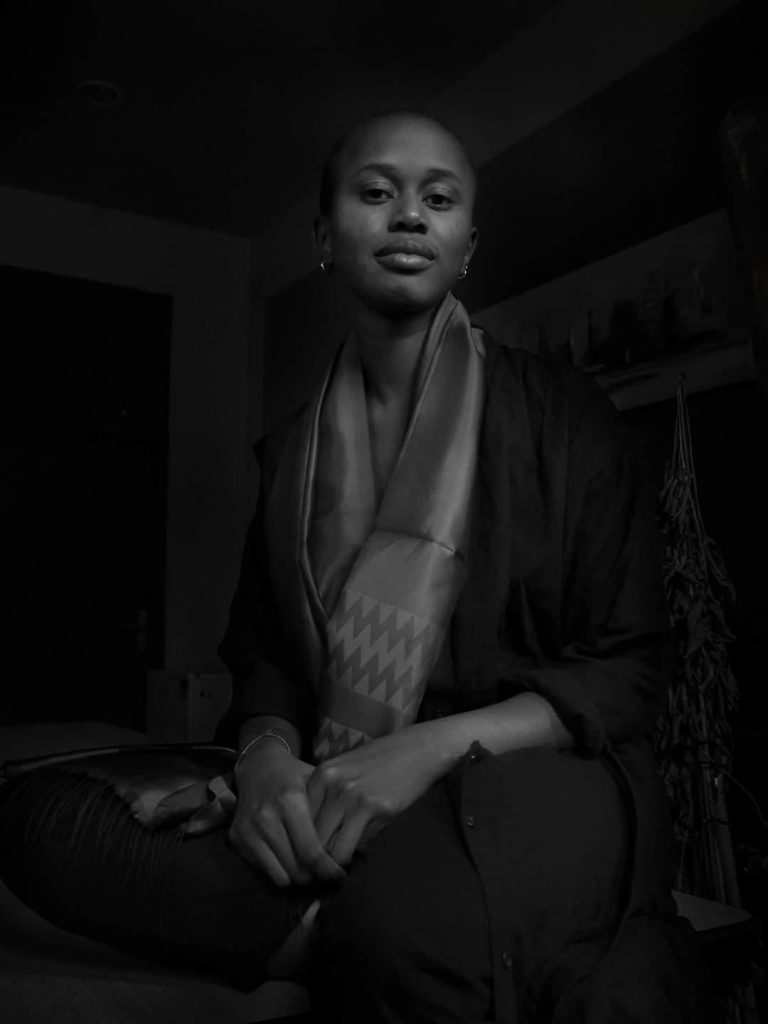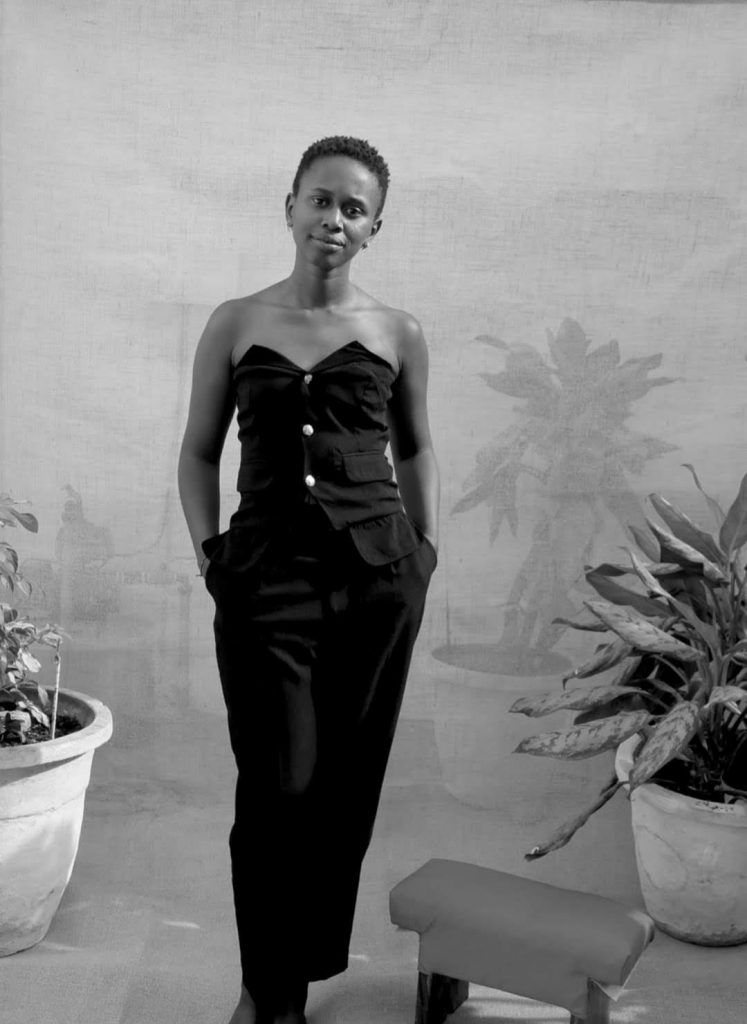
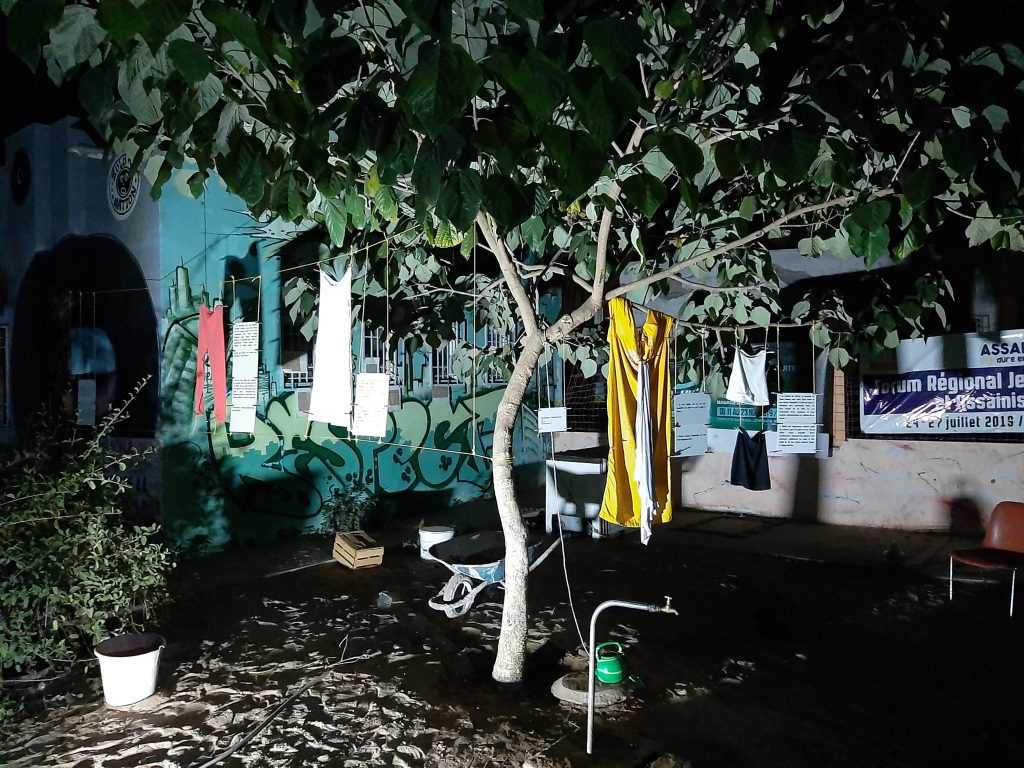
At the intersection of art curation and politics resides the force that is Fatou Kiné Diouf. A self-identified Senegalese feminist, her curatorial-activism saw her put up an ‘unusual’ exhibition in 2018. The What Were We Wearing? showcase is an ongoing campaign that seeks to centre victims and survivors of rape, while challenging the notion that the violence they’ve suffered was their own doing. The exhibition features the items of clothing that these victims had on when these acts of violence were perpetrated against them. Having first shown in universities in the USA, Diouf curated a Senegalese version to highlight rape culture in her own backyard. It was a bold project to organise – considering the cultural context – but execute it she did.
Having grown up in Senegal and studied in France, Diouf has had a myriad of experiences that have shaped her values, her politics and how she chooses to move through life as a feminist and curator. Her academic background covers English, with a major in African American Studies emphasising race, politicization and how this affects cultural production. She also has a graduate level background in Political Science. Three years into working as a curator, she spoke with me about her cultural experiences so far.
Is there a specific way you would describe your feminism? Has it been affected by your cultural and academic experiences?
My own feminism has definitely evolved because at the beginning, it was more centred on the idea of independence – but in a certain way. I was still embracing some patriarchal ideas in terms of how I would be constructing my life. I would get married, have the children, have the perfect relationship with the husband and his family and for me – this was the feminist part – be able to do it all. To work and to be a successful woman, and still take care of the family. I had that idea of being a superwoman.
What helped shift this thinking?
University helped a lot in changing my perspective because I was introduced to different types of feminist texts that got me to actually understand how society and patriarchy works. When I was younger, I’d read texts including Mariama Ba’s seminal book here in Senegal, Une Si Longue Lettre, which talked about problems that a woman encounters with family, polygamy, the death of her husband…These books are really important for me in terms of the experience of certain women around me.
What other perspectives did university give you?
It started with [learning about] the first wave of feminism; the white feminists, with those texts dwelling on inequality between genders. But then at some point I realized that there was something lacking in terms of my experience as a black woman. Also, it was lacking a more balanced perspective on culture and how it influences the way that patriarchy works, and how different people have different ways of interacting in terms of gender, and different ways of resisting it – even inside that patriarchal system. Black feminism and texts about racism introduced me to a new realm of perspectives. I got introduced to theories around intersectionality, and how it’s not just gender, but also race, class, disability etc that can actually affect the way that you move around society. Through that, and also by opening myself up to communities I’d maybe been more closed to, I got to discover afro-feminism, which I consider more particular to the European context, though it has influences from everywhere.
‘The definition of my own feminism shifted and now I consider myself a Senegalese feminist‘
What else did finding afro-feminism do for you?
I guess it reconciled me with a much more nuanced way of seeing my own culture, and also showed me groups that were thinking about and living ideas of intersectionality – groups that were so capable of talking from the point of view of different types of margins. It’s not perfect, because even inside those marginalized groups there are still issues of discrimination and misrepresentation, but intersectionality can get one to accept a person with their difference and maybe create that link of ‘I’m not going to be centring myself as your saviour but I can just listen to you and see how we can work together; how I can support you and you can support me.’
With your change of feminist politics, what were some of the impacts when you got back home?
Back in Senegal it was a different context. Even though I am black and afro-feminists are black and can be Senegalese, African or of African descent, there’s still a difference in our experience; whether it’s not being a minority or in terms of types of access, or what our priorities are. The definition of my own feminism shifted and now I consider myself a Senegalese feminist. I’m still trying to define that. I cannot just reject everything that was before. It’s a process, and so I’m seeing how I can take this from here, that from there, and make my own definition of feminism. When I’m talking about priorities it also does not mean that I would reject things that meant so much to me when I was in Europe; like sexuality, for example. They are still important and are issues that need to be fought everywhere. It’s just that maybe you fight them differently because it’s a different culture. It’s a different people; a different community.
Is this why you chose curating as a tool for your activism?
For me, curating was a means of reflection because I didn’t want to come and be like ‘these are the methods, this is how activism is supposed to be done.’ Creating something and putting it out there gives me the feeling that I’m doing something while still like looking at how activism here is done; how it’s shaped and how I can contribute to it. I think it takes time and I can’t just come, get on the field and do anything that is not appropriate here.
Let’s talk about What Were We Wearing? How did you get into that, and why an exhibition in that form?
I was invited to work on the exhibition by Marie Pierre Mbaye-Myrick – the director of the Women’s Museum here in Dakar. It was first shown in 2013 in a university in the US. The basis of it is to gather testimonies from rape survivors using a question that is often used to put the blame on them. By answering that, you end up debunking the idea that it’s their fault. You also get people to deal with and face the reality of their experience. There’s something very powerful about the fact that there’s no face. It’s just the clothes. The whole exhibition is the text, the testimony and the clothes, and I think that there’s something in that. The project started being reproduced in other cities and in other countries so in 2018, the idea came to have a Senegalese version. We got some of the testimonies from the other exhibitions and selected a few that mirrored the experience over here. We then added testimonies from women in different places in Senegal. A video testimony of Ndeye Diarra, a survivor, was also filmed by Senegalese artist Anna Karima Wane, along with two installations discussing the body and the media.
Why do you think the exhibition worked so well?
The success was not only linked to the exhibition itself, but to actually having the [different types of] people that we had around; people having a space where they could talk about their experiences and where they could bring their children and show them something that could make them discuss this issue at home. Also, people from different groups who are active on the subject helping survivors in different ways by fighting for their rights, and better treatment, and those who helped at each stage of the organisational process.
‘Sometimes I would get really frustrated at some questions that I got, and I would feel that maybe the person had not understood the exhibition or felt its message’
How much collaboration did a project of this scale require?
We actually got to collaborate with other groups to see how they worked, and it was great. This included organizations from the hip-hop association in Guédiawaye, to another one that worked around cinema, to a cultural centre and an organisation whose space is actually for housing and treating rape survivors. It was great to see how different groups reacted to the exhibition, embracing the project and seeing its value and how it was important to share it.
What do you think the audiences took away from this exhibition?
I can say that it was always…interesting for people. I cannot say that it completely changed them, but at least it was enlightening in some way, and it triggered discussions. Sometimes I would get really frustrated at some questions that I got, and I would feel that maybe the person had not understood the exhibition or felt its message, but it was important for the people to see this. For survivors also, it was important to be able to see other experiences and to see a project that was there to say, ‘This is not okay.’ It will be important to observe the long-term effects, but it was positive. I felt like the youngest ones were more curious in a way. We had all these teenagers asking questions like, ‘Why the clothes? Why this? Why that?’ and actually reading it. For me, that was the most important part. We’ve lost the adults, and so it is more about getting the youngest ones to actually see things like this. Well, we haven’t completely lost the adults. I hope.