Interview: Nana Ocran (PSP), with all images courtesy of Reem Aljeally.
Reem Aljeally has the conversational tone of a storyteller, and a spirit that’s infused by curiosity, cultural activism and integrity.
Initially an architecture student, she turned to painting after taking art classes in Khartoum. ‘I had the most amazing teacher’ she says. ‘He’s a pretty great Sudanese artist called Hatim Kuku, who always encouraged me to develop my own style.’
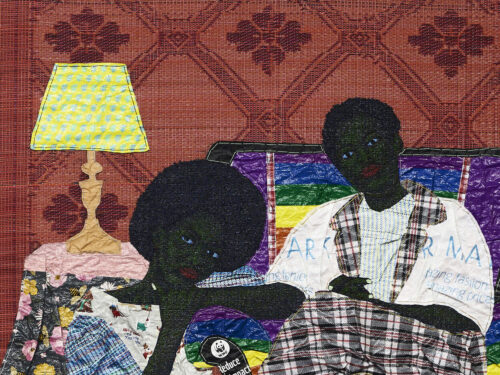
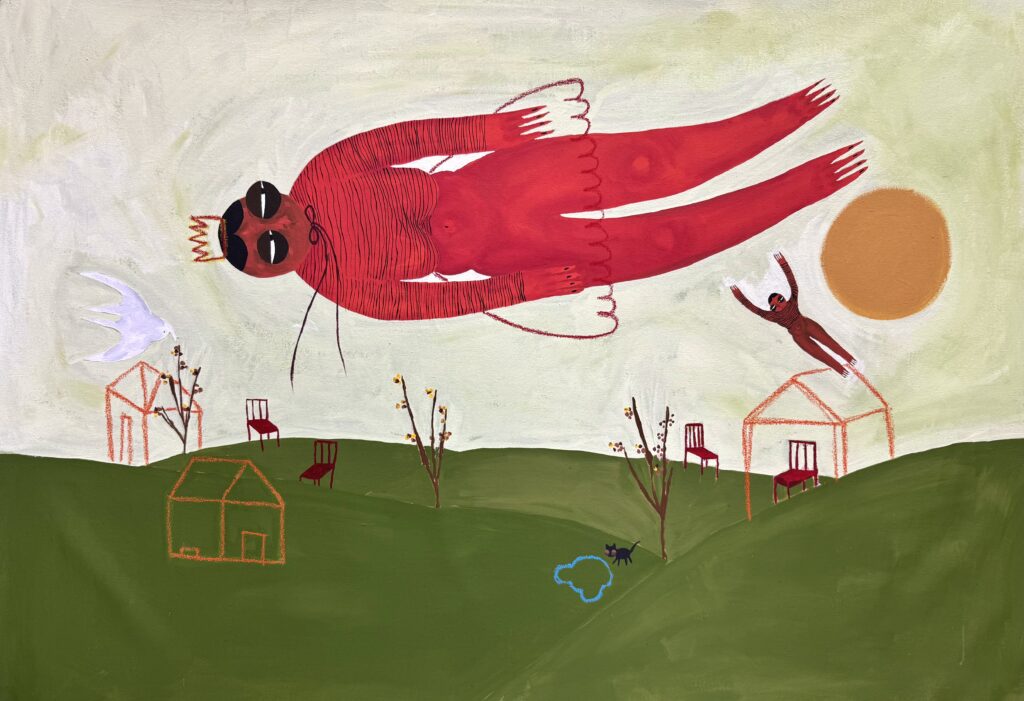
Reem’s painting practice has manifested in a central, feminine figure that she refers to as Girl with Fat Belly. To create an individual story about this character, she used still life drawing methods, by choosing plants and bottles from her own home as inspiration for how this figure forms her own house. Over time, she added elements around the girl, including a cat as a regular companion, to create an imaginary world that ‘felt like something very personal, yet a gateway to the public.’
‘If you look at my practice it has been formed in the last seven years, which are the most turbulent for Sudan …’
There are classic hues embedded within these paintings, which reflect a life back home in Khartoum. ‘We have the dusty brownish palette around us, which became prominent in Sudanese art’ says Reem, referring to the popular palette of earthy tones that are inspired by the land in Sudan and by Nuba culture. Glorious contrasts of pastel or primary colours in her own work echo the country’s individual house designs where painted exteriors in shiny green, orange, or pink all come with varying door colours. Then there’s the quirkily drawn extremities in each of Reem’s figurative paintings.
‘I’ve always struggled with painting hands,’ she explains. ‘In my figures I wanted a sense of movement, so there’s this big, bulky body, but the hands and feet are moving freely.’
It’s true. Whenever the figure appears to be mobile, there’s a sense of a weight being lifted. ‘It’s like there are no joints, so she can move in any kind of format.’
There’s a playfulness attached to the visual labelling, however, the Girl with Fat Belly – according to Reem’s mother – “got slimmer after we got to Cairo.”
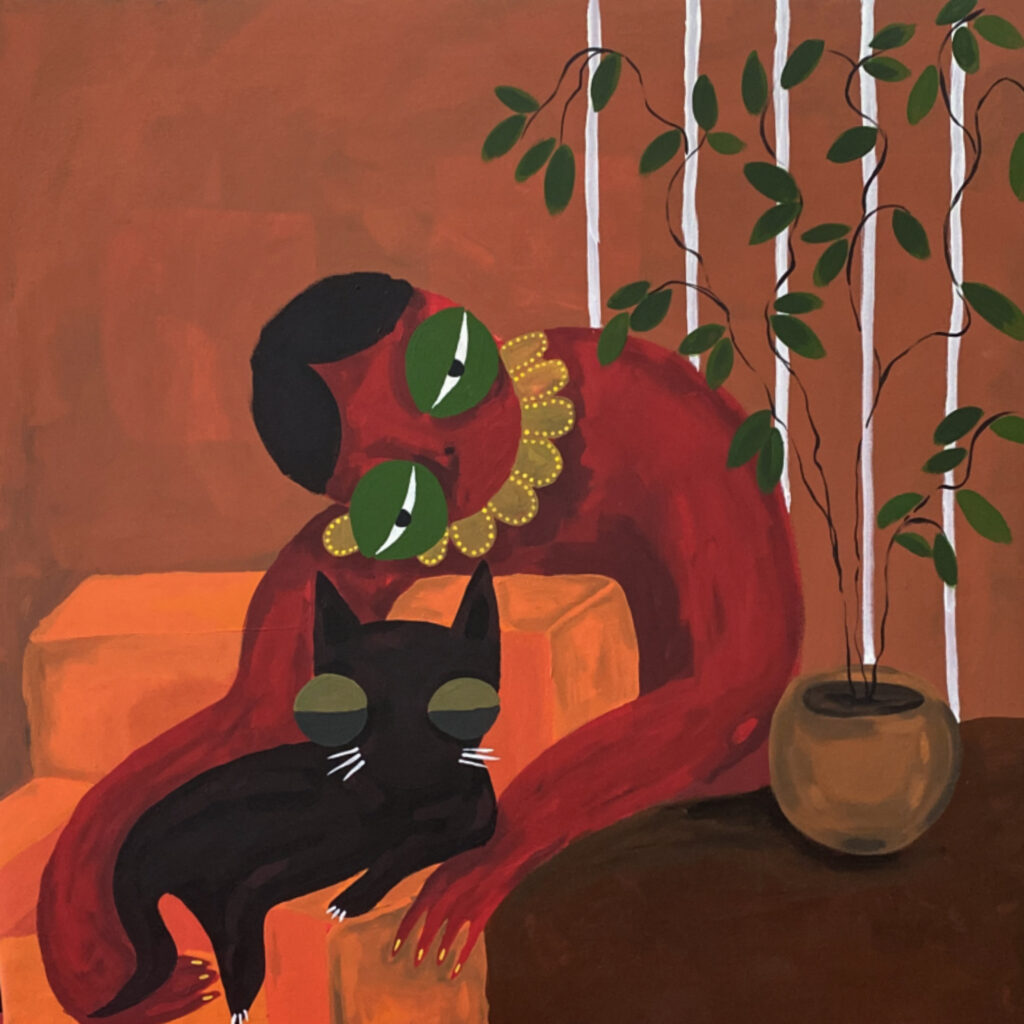
Any reduction in the subject’s physique may symbolise a mournfulness that’s embedded within the paintings, particularly in the shape of the girl’s wonderfully large and persistently hooded eyes. It’s an aesthetic physiognomy that reflects the interplay between Reem’s visually imagined world and what is actual, real, and personal. ‘If you look at my practice it has been formed in the last seven years, which are the most turbulent for Sudan specifically,’ she says, which make me wonder how her environment, and geographical shifts have impacted her work. She explains that there are clear differences in artistic tone between the work she made in the two countries she’s lived in. ‘For the paintings I created in Khartoum, there was always a room that the girl was sitting in, a space behind her, and a lot of surrounding objects. Many of the works I’ve created here in Cairo are quite blank in the background. You’ll see the figure, but there’s an abstraction or an emptiness.’
Often concerned with ideas of internal and external space and movement – both physical and geographical – Reem’s early architectural training has an ongoing impact on her visual storytelling. ‘In my art, it may not be completely visible, but in the way that I think, the way that I construct my projects and my interests, I would say that it has the biggest influence.’
This applies to her wider work, where the focus has been on specific urban themes. Displacement was at the heart of one particular project – Extended Cities: “Khartoum – Port Sudan – Cairo. This was a 2024 residency programme that was designed to consider the social and economic changes to three cities after the 2023 war outbreak. Nuanced stories featured the outcomes of metropolitan reshaping as those uprooted from Sudan brought narratives, flavours and memories from their former homes into each new location.
The project comes under the umbrella of the Khartoum-located Muse Multi Studios, which Reem founded in 2019. A home for events, residencies, publishing, and merchandise, the space proved to be a crucial starting point for Reem’s on-the-ground curatorial projects.
‘I didn’t even know what the word meant’ she recalls about her entrée into the curatorial world, which was at a time when a civic requirement for active creativity was clear. ‘In Khartoum there were not a lot of people doing this. We didn’t have any art spaces, so I felt that something was missing. Architecture and university studies gave me a lot of skills that I wasn’t able to specifically use in my painting practice, so what else could I do with that?’
‘When you’re in your country [working on] a topic that’s known to people, it’s quite different when you have to take it somewhere and introduce it all over again.’
In Khartoum, cultural production meant being surrounded by artists with lived experiences of the social and environmental contexts of the city. Things were different in Egypt. The exhibition format of Extended Cities took place in Cairo in April this year, while Decaying Bank: Reproducing Khartoum Visually, another residency programme, was showcased as an exhibition a few months earlier. For that show, Sudanese artists created visual works based on the complex identity of Khartoum. Despite the long historical connection between Sudan and Egypt, there was, for Reem, a sense of ‘bringing something foreign’ into another place.
‘Curating these shows in this specific time and with this specific theme about a city that is going through struggle right now, was very intense’ she says, also alluding to the fact that the artworks in the exhibition were printed copies. ‘To be able to make clear the reasons why none of the artworks were originals was intense because there are communities – Egyptian or international – who are perhaps a bit familiar, or unfamiliar with the context. When you’re in your country [working on] a topic that’s known to people, it’s quite different when you have to take it somewhere and introduce it all over again.’
Many of the original artworks do still exist (with minimal damage) inside the Muse Multi Studios, but recent photos that Reem has received from Khartoum show that it’s not possible to have the place open and working on the ground. ‘In Cairo we’re not thinking of having a studio at the moment,’ she says. ‘We’re collaborating with Sudanese artists from all over the world, but we don’t have physical locations.’
It’s a shame, as before the war, the Muse space had only been operating for six months, joining a modest ecosystem of Sudanese galleries that had opened up in the last few years. Creative opportunities in Egypt are different and non-comparable. The Cairo gallery that Reem now works in, part-time, has been open for 10 years, and additional spaces have been open for longer. So, what about the city’s art market?
‘I’d say it’s quite saturated’ she says. ‘There’s a high population in a city that feels confusing. It’s very noisy, very fast paced… and very stretched. I live in New Cairo, and it takes me an hour to get to downtown Cairo by car, on a highway. If I did this kind of commute in Sudan, I’d be moving to another city.’
What Reem has managed to do, from her current home base, is create collaborative partnerships such as with the Cairo Art Book Fair. ‘They’re distributing our magazine and books at fairs in London, Norway and Turkey. We’ve also been to the Sharjah Book Fair.’
A crucial project that started this year is the Sudan Art Archive. Led by Reem and a network of artists, she sees it as ‘something bigger than all of us’ due to its existence as a digital platform that tells Sudan’s evolving narrative through works by established and emerging artists. ‘We wanted to take all of this and put it in one place, maybe for people to do research. They can look up an artist, look up the specific period and a lot of artworks would come their way.’
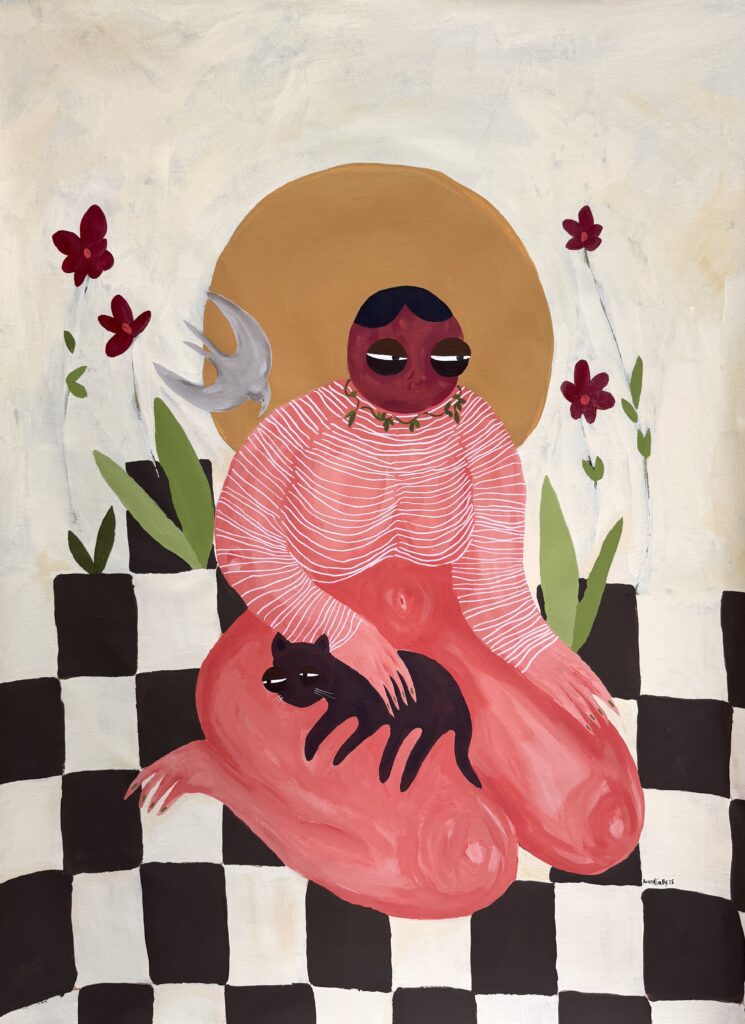
Polymath is a word that seems fair and suited to Reem, whose curatorial collectivism is adding rich and necessary depth to Sudan’s story, all with the help of important creative networks. Still, it’s the quiet and specifically insular nature of her painting practice and the look and visual tone of her central subject that seems to speak most to who she is as an artist and as a person. The earlier mention of a void or hollow presence that’s crept into the Cairo-painted and apparently slimline version of her Girl with Fat Belly, is like a symbiotic reaction. She talks about feeling personally unsettled. ‘Maybe it has something to do with moving from my country to Egypt,’ she says. ‘I’m not able to feel fully grounded.’
However, what’s powerful and encouraging about the ongoing presence of the central figure within Reem’s work, is that during the last four years, Girl With Fat Belly has been showcased in at least 8 group or solo shows, with the image being seen in Russia, Spain, Kenya, South Africa, as well as Sudan and Egypt. A London showcase was also on the cards at the time of our conversation.
Hopefully, this girl with the hooded eyes and fat belly will continue to travel with a freedom that we can follow over many more years as she grows older.
‘I hope so’ Reem laughs.
It’s a good thought. I hope so too.